Henry Broome: Wrapping wrapped in wrapping
COOP: A Novelette, by Nida Sajid. Hajar Press, 2025, 150pp, £10.00.
Published by Hajar Press, COOP is the story of how a book-loving twenty-something wrests her life back from bullshit jobs, junk consumerism and screentime. Part prose, part verse, part digital-age epistolary, the book resists any fixed sales categories. Full of brand names and literary terminology, Urdu poetry and Whatsapp messages, Nida Sajidʼs inventive, hybrid debut novel combines seemingly incongruous elements to create subversive new realities.
While finishing her PhD in Art History, Lena works as a part-time bookseller on the ʻminimum-wage floorʼ at Zestify, a design agency in the heart of Oxford Circus. She unloads deliveries and flattens boxes. Whatʼs inside doesnʼt matter. She dreams the language of haiku, portmanteau and objective correlative, but sheʼs a shelf-stacker like any other. Human relationships have been reduced to data exchange. The narrator wakes up and works through a load of unread messages from her mum and dad and co-worker Bell. Whatsapp has become an extension of her day job, a type of elective self-exploitation. Her thoughts are rented by Deliveroo, Netflix, and IKEA. Nouns are replaced by marketing speak. The narrator has a ʻGranny Smithʼ not an ʻappleʼ. Her father has an ʻAmericanoʼ not a ʻcoffeeʼ. The sale on Palestine books must mean the killing is really bad. Some passages read like Chat GPT, synonyms of synonyms of synonyms. And yet the words in COOP have been through the machine so many times that they start to take on a different set of possibilities.
The book is set in present-day London but itʼs also partly set in the screen world. In one of her Zoom creative writing classes, Lena begins thinking about the ʻsmartphoneʼ as a ʻchronotopeʼ. We are given the Oxford Reference definition: ʻA term employed by the Russian literary theorist Mikhail Bakhtin to refer to the coordinates of time and space invoked by a given narrativeʼ. Sajid turns nudges and alerts into a narrative-generating device. The text is constantly broken up by Lenaʼs nervous time checks: ʻ17:55. My phone trillsʼ, ʻ13:24. The tablet says Payment Failedʼ. On one page, there is a notification centre graphic, the font and layout of the text exactly like it is on an iPhone. This is portal beyond the page, taking you out of the story, away from the lazy, unproductive calm of reading into a state of anxious distraction. There is an instagram live video notification from @lowcalorierecipes, an email headed ʻPoem of the Dayʼ from the Poetry Foundation, Whatsapp: 3 missed calls from Bell. COOP has a physical effect on you. Youʼre made aware of the power phones have on you, how theyʼve changed how we read. The author recreates this experience on the page, in an embodied way: the split attention; those momentary, serotonin-inducing flashes of light; trying but not being able to separate online and IRL time; checking your phone every time you reach a chapter.
We never see Lena meet up with her parents IRL. She only interacts with them through email or Whatsapp. You can tell from her mumʼs emoji-filled messages that Lena is close to her but it seems like Lena has to guard her boundaries too:
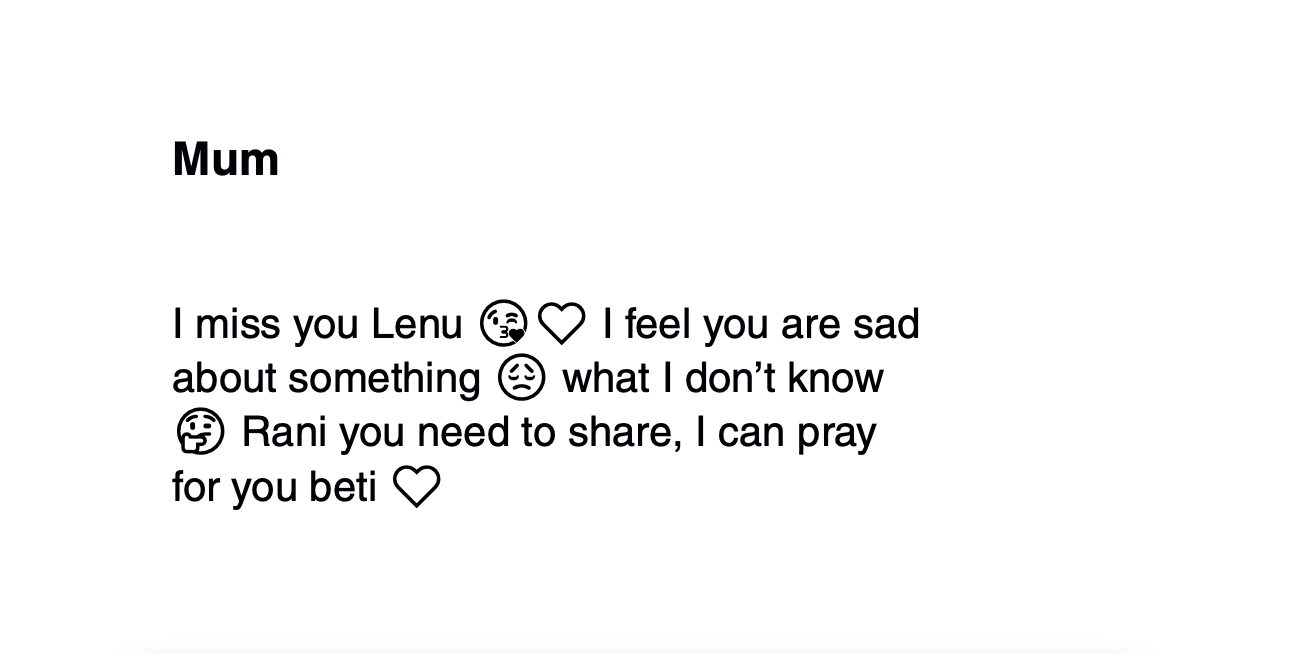
Lena has a more distant relationship with her father. He shares the odd BBC article or recommends a TV series, but doesnʼt want to intrude on her life, adding at the end of his notes: ʻRead it whenever you are in moodʼ or ʻPlease watch them if you like. Otherwise no problem.ʼ Gradually a tenderness emerges in their exchanges. At Lenaʼs request, her dad begins sending her Urdu poetry, the translated English underneath, every time with an audio file attachment of a reading, so Lena can learn to speak the language of her parents the way they speak it. ʻIn Urdu poetryʼ, says her dad, ʻit is important how you recite it. With the rise and fall of your voice the chords of your heart should also vibrate.ʼ For Lena, these exchanges become a way to self-discovery.
Messaging her parents allows her to engage with a part of herself that is more difficult to access within the other IRL relationships in her life, or actively blocked off to her as a brown woman in the UK, because of the racism she encounters. Lena is on a Hinge date with a self-described ʻfellow socialistʼ who asks her, ʻSo. Tell me. How do you reconcile your Pakistani heritage with your left-wing politics?ʼ, suggestively supporting the colonialist idea of non-Western countries as anti-progressive, bound by backward cultural traditions. Lena say nothing. She takes herself out the scene. She begins self-narrativising, retreating into the pleasure of words: ʻI stare until the glare reaches the recesses of my eyelids, coating soft folds of skin in thick layers of red, coppery and opaque.ʼ We see Lena, in her young adult years, constructing her selfhood in her own way, becoming the person she wants to be. Sheʼs not trying create herself completely new. She draws from different outside sources, taking what she likes, refusing what she doesn’t; but there’s also something that comes from inside that sheʼs decided she wants to nurture.
ʻThree years at the bookshop have reduced literature to a commodity.ʼ says Lena. The Zestify cafeteria advertises ʻfragrant and flavourful food to fuel your day.ʼ (Digestion is a recurring motif in the novel). The alliterated advertising copy, the soft food they serve in the cafe, the ʻ#timelyʼ books they sell on the same floor, itʼs all the same: market ready, easy to consume, limited chewing required, disposable – fast food, fast books. (COOP is subtitled ʻA Noveletteʼ – ʻDonʼt worry this little book wonʼt hurt your head too muchʼ, Sajid tells us tongue in cheek.) The stale rice cake stuck in Lenaʼs throat feels like a bit of styrofoam plate, she thinks to herself – slowly weʼre becoming the plastic packaging our food comes with, our bodies infiltrated by capitalismʼs waste products, the microbeads, teflon… Maybe the written word is becoming a kind of cellophane wrapper too now. Postmodern culture, Frederic Jameson says, produces no new modes of artistic expression; itʼs all the same stuff just packaged in a different way, wrapping wrapped in wrapping. Literature just becomes quotation, especially now. Lenaʼs dad proudly tells her that heʼs been experimenting with ChatGPT. In a later message to Lena he confesses, ʻWhen you were born I never thought that you are a special person. Did not give you so much attention. This is a great guilt in my heart.ʼ Was that AI-written? Would it make it any less sincere or heartrending? Does COOP point to something redeemable in these exploitative technologies?
Sajid skilfully shows us how language is reinventing itself to keep pace with the marketʼs demand for freshness. Lena and Bell exchange recently new colloquialisms that already seem tragically outdated: ʻpass-aggʼ, ʻobsessedʼ, ʻlove that for youʼ. Even the language of community has been commodified today. A ʻco-opʼ is now a place to buy overpriced essentials. The dialogue and the streets Lenaʼs inhabits are full of left-wing rallying cries, ʻAbolish landlordsʼ, ʻEat the Richʼ, ʻFuck Borisʼ, phrases that have become mere slogans, or now only conjure disappointment and defeat. ʻNeoliberalʼ, ʻgig economyʼ – the terms Lena and Bell use to describe the problem have lost some of their bite. Capitalism is mutating faster than we can describe it.
Sat on the computer at work, Lena receives an email from Pluto Press, subject line: ʻFree Palestine! A Reading Listʼ followed by a watermelon emoji. Then, a customer comes in to the bookshop and picks out a cookbook by Yotam Ottolenghi, the British-Israeli chef and restauranteur accused of appropriating Palestinian cuisine. Palestinian identity is insidiously being commodified and consumed. The woman with ʻcoffin-shaped nailsʼ says, ʻI feel like food is all we have at the moment, given everything that’s happening in the world.ʼ Her dad is Israeli she says, adding ʻit’s been so horrible for our family because the media here is terribly biased.ʼ Words are endlessly manipulable. Oppressor can become oppressed. As the customer leaves, her face ʻcleavesʼ, a classic example of a contronym, a term for a word with two opposing meanings. ʻCleaveʼ can mean to split or divide, or to join or stick together, evoking contradictions of Israelʼs colonial project, its refusal to recognise the existence of Palestine while constantly expanding into it. Sajid leaves coded clues pointing to the way power and violence work through words, how they have this pliableness that can be exploited for evil but maybe also for good.
Trying to escape Zestify, Lena applies for an Art History assistant lecturer position at the made-up Institute of Creative Arts. When she unexpectedly gets the job, sheʼs over the moon but soon finds out sheʼs only scheduled for 4-hoursʼ teaching a month, meaning sheʼll have to stay on at the bookshop, and sheʼll still just barely make rent. Lena realises that, whatever she tries, Zestify or academia, trying to make her love of books pay just kills the enjoyment for her. She has to deal with a new colleague who doesnʼt see anything wrong with teaching a workshop on the politics of protest while thereʼs a strike on, and the university seems less interested in Lenaʼs ideas than leveraging her identity for their brand image, pressuring her into selling her ʻintersectionalityʼ to the students.
Lena seems to be faced with two choices: accept the logic of capitalism, let it exploit the things that make her happy, or withdraw from life completely. But maybe thereʼs another way. Maybe we can turn the marketʼs logic against itself? The novelʼs deviant form and structure comes out of all the things Lena and the other characterʼs buy, the type of literature Ursula Le Guin might have imagined when she came up with her ʻCarrier Bag Theory of Fictionʼ. COOP is, not a linear narrative story about male heroics and overcoming the odds, conflict followed by resolution – ʻI wonder what life would be like if war weren’t a metaphor we lived byʼ, Lena says after passing her dissertation ʻdefenceʼ. Instead, Sajid reimagines a story as a container for a miscellaneous variety of things, to create powerful and unexpected new relations between objects, ideas and people.
Lena notes the ʻenjambmentʼ of the Co-op logo split over two lines. Sheʼs reading marketing like a poem, reading against the text, deconstructing language the way sheʼs been taught at university— literary analysis as an essentially anti-capitalist activity that teaches you to defamiliarise the world, to question the way things appear. Lena creates something resembling a one-act play from a trip to the supermarket, the product copy, ʻbloomer bread, / thickly slicedʼ, ʻLurpak / lightly saltedʼ, organised in vertical columns like shopping aisles; the store signage, ʻENTERʼ and ʻEXITʼ at the top and bottom of the page, now the stage direction; the self-checkout voiceover ʻan automated soliloquyʼ. On her Zestify shifts, Lena recites the alphabet under her breath as she unscrambles row after row books. Letters are free-floating around in her head all day. When her boss isnʼt in, Lena removes pro-Israeli titles from the Middle East and North Africa shelf and hides them in a drawer. Nida Sajidʼs book shows us we have more power than we think, already right now. Living out your aspirations, resisting hate and exploitation doesnʼt require changing everything all at once or imagining a completely new world to replace the old one. We just have to see dream-crushing reality through new narratives, turning the marketʼs tools against itself, remaking, reorganising, restructuring whatʼs already there, ʻarranging a coup d’état in miniature every dayʼ, as the narrator says, quoting Marx.
Henry Broome is a writer and critic from London.
